 ProNexus Admin
How to Build Board-Ready Nonprofit Financial Reports
 ProNexus Admin : Aug 19, 2026, 8:00:00 AM
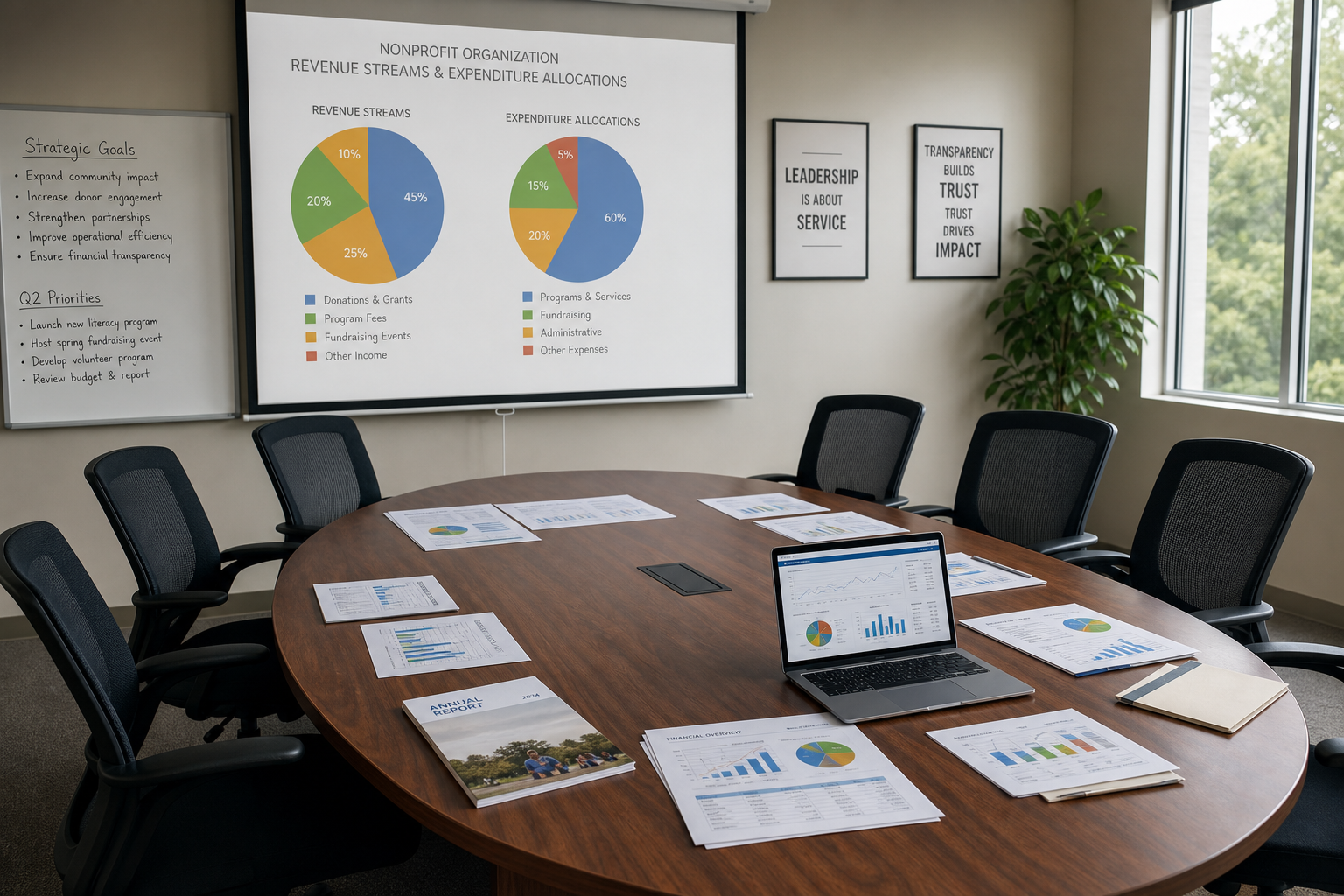
Learn how to create board-ready nonprofit financial reports that enhance transparency, improve oversight, and facilitate informed decision-making.

When financial reporting becomes slow or overly manual, replacing the ERP can seem like the obvious solution.
But it is not always necessary.
Organizations can often automate and improve financial reporting without replacing their ERP by connecting existing financial and operational data to a separate reporting and analytics environment.
The ERP can continue doing what it was designed to do: process transactions and maintain the accounting records.
The reporting environment can focus on turning that information into something leadership can use.
Many finance departments have capable accounting systems and still rely heavily on Excel.
That is because the information executives need rarely comes from one place.
A CFO may need data from:
Finance teams often bridge those systems manually.
Employees export reports, combine files, update formulas, reconcile totals, and reformat the information every month.
The problem is not necessarily the ERP. It is the process of bringing the data together.
If your close process is already slowing down reporting, you may also want to read Why Is Month-End Close Taking So Long? 8 Problems to Look For.
Financial reporting automation uses technology to reduce the repetitive manual steps involved in collecting, organizing, calculating, and presenting financial information.
Depending on the environment, automation can help with:
Automation does not eliminate the need for finance professionals.
It reduces the time spent assembling information so finance professionals can spend more time reviewing and interpreting it.
Not necessarily.
If the ERP handles accounting transactions effectively, replacing it solely because reporting is difficult may introduce unnecessary cost and disruption.
Instead, finance leaders should determine exactly where the reporting process breaks down.
Ask:
The answers help determine whether the problem is the ERP itself or the reporting layer around it.
For a broader look at the operational side of this question, see What Is Finance Transformation?
A modern reporting environment can connect multiple data sources and present information through dashboards and standardized reports.
For example:
ERP + CRM + payroll + operational systems → centralized data → reporting and analytics → dashboards and management reports.
Instead of rebuilding the reporting package each month, the underlying information can be refreshed.
Finance still performs appropriate review and validation, but much of the repetitive assembly process is reduced.
ProNexus supports this type of reporting environment through business analytics and outsourced FP&A services that help connect data to decision-making.
The opportunity varies by organization, but common examples include:
Income statements, balance sheets, cash flow reporting, and departmental reports can often be standardized.
Actual financial results can be compared with budgets and forecasts without manually updating large workbooks every reporting period.
Executives can monitor selected financial and operational KPIs through dashboards rather than waiting for static reports.
Recurring board packages can be streamlined when the underlying reports and metrics follow a consistent format.
Financial results can be combined with nonfinancial measures such as headcount, utilization, sales activity, production, patient volumes, or other industry-specific KPIs.
The most obvious benefit is time, but it is not the only one.
Automation can also help organizations:
Ultimately, the goal is better decision support.
A beautiful dashboard has limited value if management does not use it to make decisions.
Do not begin by trying to automate every report.
Identify the reports that require the greatest manual effort or provide the greatest value to management.
Document how each report is currently created:
This creates a practical roadmap for automation.
If delayed close cycles are part of the problem, How Long Should Month-End Close Take? A Guide for CFOs and Controllers offers another useful benchmark.
ProNexus helps organizations improve financial reporting through a combination of finance expertise, process improvement, technology, and analytics.
That can include automated financial reporting, business intelligence, dashboard development, data integration, FP&A support, and broader finance transformation.
Organizations that need senior finance oversight alongside reporting improvements may also benefit from virtual CFO and Controller services.
Because reporting requirements should be driven by the business, our approach starts with understanding what finance and leadership need to see rather than beginning with a particular technology.
Yes. Many repetitive parts of financial reporting can be automated, including data consolidation, report refreshes, recurring calculations, dashboards, and budget-to-actual reporting.
Power BI can connect with many data sources and can be used as part of a reporting environment that incorporates ERP and other business information. The appropriate architecture depends on the systems involved.
Not necessarily, nor does it need to. Excel remains valuable for analysis and ad hoc work. The goal is to reduce repetitive manual processes that require rebuilding the same reports every month.
No. Organizations may be able to improve reporting through integrations, analytics tools, data architecture, process improvements, or reporting automation while retaining their existing ERP.
The accounting system should maintain reliable financial records.
It does not necessarily have to be the only tool used for management reporting, analytics, and decision support.
For organizations struggling with manual financial reporting, ProNexus can help evaluate the current process and determine how existing systems, automation, and analytics can work together more effectively.


 ProNexus Admin : Aug 19, 2026, 8:00:00 AM
Learn how to create board-ready nonprofit financial reports that enhance transparency, improve oversight, and facilitate informed decision-making.
 ProNexus Admin : Sep 23, 2026, 2:40:12 PM
Learn how finance transformation enhances decision-making by aligning people, processes, technology and data to improve financial operations and...
 ProNexus Admin : Feb 10, 2026, 6:45:00 AM
Discover how outsourced accounting services ensure compliance and accurate reporting, leveraging expertise, technology, and scalable solutions for...